

Quick answer: Short fiction can place a reader inside the experience of mental illness with a force that clinical description rarely reaches. The best short stories about mental illness treat a character as a whole person rather than a symptom, refuse the myth of the dangerous patient, and let the reader feel the logic of a mind under strain from within. This guide, written by a psychiatrist who also writes fiction, applies that standard to a handful of stories worth reading, both classic and contemporary.
For readers who go looking for short stories about mental illness, the internet tends to offer long alphabetical lists and little judgment about which portrayals are honest and which quietly repeat old myths. This guide takes the opposite approach. It is short, curated, and built around one question a practicing clinician keeps asking of any story that reaches for a troubled mind. Does it get the person right?
- What short fiction shows about mental illness that facts cannot
- What separates an accurate portrayal from a stereotype
- Classic short stories that saw mental illness clearly
- How a psychiatrist reads these stories differently
- A contemporary short story collection written by a psychiatrist
- How to read stories about mental illness with care
What short fiction shows about mental illness that facts cannot
Short fiction shows the inner logic of a distressed mind, the part a symptom list can name but never let you feel. A case note records that a patient hears voices or cannot rise from bed. A story lets you sit inside the hour when the voice will not stop, or when the bed has become the only safe place in the world. That shift, from description to inhabitation, is the reason fiction about mental illness earns a reader’s time in the first place. Statistics can tell you that depression is common. Only a story can show you the particular Tuesday on which a capable adult finds the short walk from the couch to the kitchen genuinely impossible, and make that impossibility make sense.
The short story is unusually suited to this work. Its compression forces a writer to strip away the scaffolding and drop the reader straight into a consciousness, often in only a handful of pages. There is no room for a tidy diagnosis or a reassuring cure, only the texture of the experience as it is lived. This is exactly what the long alphabetical lists of titles never explain. They tell you a story exists without telling you why reading it might change how you understand a person.
There is reason to think fiction does something we can almost measure. A recurring line of psychological research on reading suggests that literary fiction can strengthen theory of mind, the everyday skill of inferring what another person thinks and feels. I would not oversell the finding, and the careful researchers do not either. Yet it matches what four decades of practice taught me. The colleagues and families who understood mental illness best were seldom the ones who had memorized a manual. They were the ones who had, somewhere, been let inside another mind, and a good story does precisely that.
What separates an accurate portrayal from a stereotype
An accurate portrayal of mental illness in fiction keeps the character a whole person, resists the violence trope, and gets the interior texture of the symptom right. A stereotype does the reverse. It flattens a human being into a diagnosis, reaches for shock, and borrows its idea of illness from other movies rather than from life. The difference is not a matter of sympathy. A writer can be sympathetic and still get it badly wrong.
Most articles that promise realistic fiction assert the word and move on. It is more useful to name what accuracy actually asks for. Over the years I have come to read these portrayals against a short set of markers, offered here as craft criteria to sharpen a reader’s eye, not as clinical tools and not to diagnose anyone.
- The character stays a whole person. Illness is one thread in a life that also holds work, love, humor, and history, not the only fact about them.
- It refuses the dangerous-patient myth. Most people living with serious mental illness are not violent, and are far likelier to be harmed than to harm. Fiction that treats psychosis as a synonym for menace is repeating a falsehood.
- The symptoms carry the right texture. Auditory hallucinations, for instance, are far more common than the vivid visual kind film prefers, and a voice is usually running commentary or command rather than a picture projected on the wall.
- There is no shock for its own sake. Sensationalized breakdowns and gore signal a writer reaching for effect instead of truth.
- The arc resists the neat cure. Real recovery is uneven, partial, and slow, and honest fiction rarely resolves it in a single closing scene.
The neat cure deserves special caution, because it is the kindest-looking distortion. A final scene that dissolves a serious illness in a single insight sends a quiet, false message to real readers still living with it, that the recovery they have not reached was always one epiphany away. Honest fiction is gentler with its characters and, oddly, gentler with its readers, because it does not promise what medicine cannot.
None of this asks a story to read like a textbook. It asks the writer to have looked closely enough that a reader who has lived the experience would recognize it, and a reader who has not would still believe it.
Classic short stories that saw mental illness clearly
Several stories from the public domain and the wider canon still set the standard for rendering a mind under strain, long before the vocabulary of modern psychiatry existed. They are grouped here by the terrain they cover, psychosis and the divided mind first, then depression and quiet despair. Each is discussed at the level of theme and craft, with its ending left intact.
Stories of psychosis and the divided mind
The strongest short stories about psychosis render the experience from the inside, so the reader follows the character’s reasoning even as it detaches from shared reality. Three older works do this unusually well.
Nikolai Gogol’s “Diary of a Madman” (1835) is told as the journal of a low-ranking clerk whose entries slide, almost imperceptibly, from petty grievance into the conviction that he is the King of Spain. What Gogol gets right is the internal consistency of delusion. The clerk is not raving. He is reasoning, carefully, from premises that have quietly come loose, and that quiet plausibility is exactly how a fixed false belief tends to feel from within.
Charlotte Perkins Gilman’s “The Yellow Wallpaper” (1892) follows a woman confined to a room for a rest cure and told, for her own good, to do nothing at all. Her narration tightens as the enforced idleness curdles into an obsession with the pattern on the wall. Gilman, who endured that cure herself, captures how isolation and the denial of a person’s own account of their state can worsen rather than heal, a caution the story still delivers to anyone tempted to silence a patient in the name of care.
Edgar Allan Poe’s “The Tell-Tale Heart” (1843) traps the reader inside a narrator who insists on his sanity while describing the very reasoning that betrays it. The famous sound beneath the floor is an auditory experience he cannot escape, and Poe uses the first person to hold us in that logic rather than let us watch from a safe distance. It remains one of the clearest renderings in short fiction of a mind that can no longer tell its inner signal from the outer world.
Across all three, the craft lesson is the same. Psychosis becomes believable on the page not through spectacle but through reasoning the reader can follow one step at a time. A sensational version reaches instead for menace and gore and, in doing so, tells the reader nothing about what the experience is actually like. That restraint is the harder, more responsible way to write it, and the reason these stories have lasted.
Stories of depression, grief, and quiet despair
The best short stories about depression rarely look dramatic. They capture flatness, numbness, and the slow retreat from life, because that is how the illness usually presents, not as weeping but as a dimming of everything. Three works hold that quiet register with particular honesty.
Herman Melville’s “Bartleby, the Scrivener” (1853) gives us a copyist who meets every request with the same soft refusal, “I would prefer not to,” and withdraws by degrees from work, food, and the world. Melville never labels the condition, which is the point. He renders the affect from the outside, the way a colleague or a family member first meets it, as an inexplicable and immovable not-doing that no amount of reasoning can reach.
Ernest Hemingway’s “A Clean, Well-Lighted Place” (1933) sits with an old man drinking alone late at night and the older waiter who understands why the light and the order matter to him. In its restraint, and in the waiter’s meditation on nothingness, it captures the particular despair of age and insomnia without a single melodramatic gesture. The story trusts emptiness to speak for itself, which is why its portrait of geriatric depression lands so hard.
James Joyce’s “The Dead” (1914) closes on a man’s slow recognition, at the end of a winter party, that his wife has carried a private grief for years and that he has understood little of the people around him. The final image of snow settling over the living and the dead is grief and mortality rendered as quiet rather than spectacle. It shows how mourning and emotional numbness can coexist with an ordinary evening, which is usually where they actually live.
What unites these three is restraint. Each trusts the ordinary surface of a life to carry the weight of what is wrong beneath it, and that is why they read as true instead of staged. Much of what we call depression is the loss of interest in what once mattered, and on the page that absence is far harder to render than tears. A writer has to make the reader feel the color drain out of a scene, which is exactly the craft these three quietly master.
How a psychiatrist reads these stories differently
A psychiatrist reads these stories with a specific question running underneath the plot. Is the behavior internally consistent, are the family and clinical dynamics plausible, and does the story resist the easy myths. It is less a search for accuracy in the fussy sense than an ear for whether a mind on the page moves the way minds actually move.
For 42 years I practiced clinical and forensic psychiatry, much of it spent listening to people describe states they could barely put into words, and much of it, in the forensic work, spent testing whether an account held together at all. That habit does not switch off when I read. I notice when a character’s collapse arrives too neatly on cue, or when a delusion is treated as a costume rather than a logic. I have written more about that particular challenge in how to write schizophrenia without the stereotypes [CONFIRM: exact published slug and live status of the sibling post Writing Schizophrenia Without the Stereotypes, which may not be live at launch]. I also notice when a writer with no clinical training gets it exactly right, which happens more often than doctors like to admit, because close attention to another person is its own kind of training.
I remember how often a first session began not with a symptom but with a silence, or a joke, or a complaint about parking, the real matter arriving only sideways. Fiction that knows this, that lets distress enter a scene obliquely, tends to be the fiction that gets people right. What I look for is never a correct label. The best fiction is not obligated to diagnose and rarely does. I look for whether the writer has honored the interior life of the character enough that the illness reads as something happening to a person rather than something standing in for one. That reading method, more than any single title, is what I hope you take from a page like this one, written by Gene Altman, a psychiatrist who writes fiction.
A contemporary short story collection written by a psychiatrist
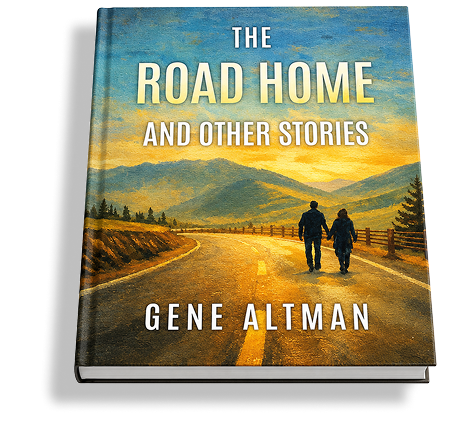
Contemporary short fiction written by a practicing clinician is rare, which is part of why I wrote some. The psychiatrist-written stories in The Road Home and Other Stories belong to the same realist tradition as the classics above, and mental illness is one of the collection’s dominant themes, rendered with clinical care rather than spectacle. This continues a long lineage, the long tradition of doctors who write fiction [CONFIRM: exact published slug and live status of the sibling post The Long Tradition of Doctors Who Write Fiction, which may not be live at launch].
The book gathers 18 stories set in six American states and two foreign countries, following ordinary people through adversity, loss, and the search for belonging. Several of the stories feature psychiatrists as characters, and several move close to states of mind I spent a career trying to understand, delusion, despair, and the quiet forms of courage that illness can call up. I will not spoil their turns here. It is enough to say the aim throughout was the standard described above, to keep each character a whole person and to let the reader feel the logic of a life from within.
Not every story turns on illness, and that is deliberate. Belonging, aging, marriage, fathers and sons, and the search for home run alongside it, because that is how mental health actually sits in a life, braided into everything else rather than sealed off from it. A story that isolates a diagnosis from the rest of a person has already lost the thing worth writing about.
One thing I want to state plainly, because the whole subject rests on trust. The stories are fiction. They depict no real patients and no real cases. What they carry out of the clinic is not anyone’s history but a way of paying attention, the same attention that, on a good day, lets one person genuinely imagine another.
Read more about the themes and stories in The Road Home and Other Stories
How to read stories about mental illness with care
Read stories about mental illness at your own pace, and choose a moment when you have the room to feel them. This material is meant to move you, and finding it heavy is a sign the writing is working, not a failing in you as a reader.
A few small practices help. Let yourself stop between stories rather than reading a whole collection in one sitting. Notice which pieces press on something personal, and give those extra space afterward. If a story stirs up more than you expected, set it down. It will still be there later, and there is no prize for finishing quickly. Fiction about these subjects rewards the slow reader, the one willing to sit with discomfort long enough to understand it. If you are reading to understand someone you love, resist the urge to turn a story into a diagnosis of them. Let it enlarge your sympathy rather than sharpen your conclusions, since a novel or a story was never meant to be a clinical instrument.
Read with care, these stories can also do something quietly useful. They make the experience of mental illness less foreign, both to those who have lived it and to those who love someone who has, and that is how honest fiction chips away at stigma, one imagined life at a time. If any of this touches your own life, please know that difficulty of this kind is common, it is human, and support exists for anyone who is struggling.
Frequently Asked Questions
- What are the best short stories about mental illness?
Strong, verifiable starting points include Charlotte Perkins Gilman’s “The Yellow Wallpaper,” Nikolai Gogol’s “Diary of a Madman,” and Edgar Allan Poe’s “The Tell-Tale Heart” for psychosis, and Herman Melville’s “Bartleby, the Scrivener” and Ernest Hemingway’s “A Clean, Well-Lighted Place” for depression and despair. For a present-day example written by a practicing psychiatrist, The Road Home and Other Stories treats mental illness as one of its central themes. The best choice depends on which experience you want to understand from the inside.
- Why read fiction about mental illness instead of nonfiction?
Fiction lets you inhabit an experience from the inside, which builds empathy in a way a symptom list rarely can. Both forms have value, and nonfiction remains essential for facts and treatment, but a story can make a mind’s inner logic something you feel rather than only read about. A recurring line of psychological research also suggests that literary fiction can strengthen the ability to imagine other people’s thoughts and feelings.
- What makes a portrayal of mental illness accurate?
An accurate portrayal keeps the character a whole person, resists the myth of the dangerous patient, and gets the texture of the symptom right rather than borrowing it from other films. It avoids shock for its own sake and rarely ends in a tidy cure, because real recovery is uneven. These are craft criteria for reading fiction, not tools for diagnosing anyone.
- Are there short stories about mental illness written by a psychiatrist?
Yes. The Road Home and Other Stories is a 2026 collection of 18 literary short stories by Gene Altman, a psychiatrist who practiced for 42 years, and mental illness is one of its dominant themes. The stories are fiction and depict no real patients or cases. They bring a clinician’s attention to ordinary people rather than any actual clinical history.
- How should I read stories about mental illness if the subject is hard for me?
Read at your own pace, pick a moment when you have room to feel the material, and remember that finding it difficult is human, not a failing. Let yourself pause between stories and set a piece down if it stirs up more than you expected. If any of it touches your own life, please know that support exists for anyone who is struggling.