
This guide covers the history of doctors who became writers, the reason medicine keeps producing storytellers, and where to start reading. Jump to the section you need.
- Why do so many doctors end up writing fiction
- Which famous doctors became writers, from the nineteenth century on
- Are there psychiatrists who write fiction
- What medicine gives a storyteller that nothing else can
- The quiet link between short stories and medicine
- A psychiatrist writing in that tradition now
- Where to start if you want to read a physician-writer
The list is longer than most readers expect, and it runs from the 1800s through to novels published in the last few years. Some of these writers closed the practice once their books found an audience. Others kept both lives running at once, seeing patients through the day and writing at night for decades. What follows is who they were, what medicine actually teaches a storyteller, which physician writers are working right now, and which book to pick up first.
Why Do So Many Doctors End Up Writing Fiction
Medicine and fiction depend on the same core skill, the close observation of people under pressure. That overlap, not spare time or coincidence, is the honest answer to why doctors write fiction in such numbers.
The training builds the skill deliberately. From the first weeks of clinical work, a medical student is taught to take a history, which means sitting with a stranger and drawing a life story out of them in the short window before a decision has to be made. The student learns to notice what the patient does not say, to read a hesitation, to catch the detail that does not fit the account being offered. A doctor assembles a coherent human narrative out of fragments and then acts on it. A novelist does the same work in the opposite direction, building the fragments so that a reader can assemble the person.
There is a recognized name for that link. Narrative medicine is an established field, taught at Columbia University and elsewhere, which trains clinicians in close reading and reflective writing on the argument that a doctor who can follow a story properly is a better doctor. Medical schools did not invent the connection between medicine and storytelling. They gave a formal name to something practicing clinicians had been doing privately for well over a century.
The second half of the answer is exposure. Doctors accumulate experience most people are shielded from, the moment a diagnosis lands, the family conversation in a corridor, the patient who says the one true thing on the way out of the room. Some of that material does not resolve on its own. Fiction is one of the few places a clinician can hold it, because fiction allows a doctor to tell the truth about an experience without telling the truth about a person. That is why so many physician writers reach for invented characters rather than memoir.
Understood that way, a clinician who starts writing fiction late is not making a career change. It is the same attention, pointed somewhere new.
Which Famous Doctors Became Writers, From the Nineteenth Century On
Many of the most influential writers in the Western canon trained or practiced in medicine before they were known for anything they wrote. The doctors who became writers below all held real medical credentials, and in every case the training is visible in the work. They are grouped by era, historical figures first and living authors second, because the point is that this is a continuing line rather than a closed chapter.
The Nineteenth and Twentieth Century Masters
The 19th and early 20th centuries produced the writers who set the pattern. Every writer below qualified in medicine, and each carried something specific out of the consulting room and onto the page.
Anton Chekhov
Qualified in medicine at Moscow University in 1884 and is now regarded as a founder of the modern short story. He kept treating patients while he wrote, and in an 1888 letter he described medicine as “my lawful wife” and literature as “my mistress.” His stories carry the clinical habit directly, watching a life closely without ever passing sentence on it.
Arthur Conan Doyle
Trained in medicine at Edinburgh and practiced before Sherlock Holmes made writing his living. Holmes was modeled in large part on Joseph Bell, one of Doyle’s medical teachers, who was known for reading a patient’s occupation and history off small physical details on sight. The most famous detective in English fiction is, in effect, a diagnostician.
William Carlos Williams
Kept a pediatric and general practice running for roughly 40 years while producing some of the defining poetry of American modernism. He wrote between appointments rather than instead of them, and the work is built on the plain, exact, unsentimental noticing that a full clinic demands.
Somerset Maugham
Trained at St. Thomas’s in London and qualified as a physician before his writing took hold. He left medicine once his fiction succeeded, which makes him the clearest case of a writer who used the training as an apprenticeship in human behavior and then closed the practice for good.
Mikhail Bulgakov
Practiced as a physician and turned his own early years in the job into A Young Doctor’s Notebook, a linked sequence about a newly qualified doctor posted somewhere far beyond his competence. It is one of the purest examples of medicine feeding fiction directly, written from inside the panic rather than remembered fondly afterward.
The Doctors Writing Fiction Today
The tradition is current, not historical. Doctors are publishing serious fiction right now, and several of the most widely read novels of the past 20 years were written by people who trained in medicine.
Abraham Verghese
A physician and professor at Stanford who writes fiction alongside a full academic and clinical career. His novel Cutting for Stone is the most widely read contemporary example of a doctor’s novel that treats medicine as material rather than as backdrop.
Khaled Hosseini
Practiced as an internist before The Kite Runner became an international best-seller. His books are not medical novels at all, which is itself instructive, because the training shows up as attention to how people carry damage rather than as hospital scenes.
Robin Cook and Michael Crichton
Both trained as doctors, and both built large commercial careers on the medical and scientific thriller. This is the loudest lane of the tradition and the one most readers meet first, though it is also the narrowest way to understand what medicine gives a writer.
Are There Psychiatrists Who Write Fiction
Yes, and psychiatry has an unusually strong pull toward fiction, because it is the branch of medicine that deals almost entirely in the inner life. A cardiologist reads a heart. A psychiatrist reads motive, mood, fear, self-deception, and the story a person tells about their own life, which is the same set of materials a novelist works with.
The consulting room sits closer to the novelist’s desk than any other clinical setting does. A psychiatric assessment is largely a person explaining themselves at length, and a good deal of the clinical skill lies in what the explanation reveals unintentionally. The psychiatrist listens for the gap between the account and the life, tracks how a person narrates their own past, and pays attention to what a patient keeps circling back to. Those are the working habits of a literary novelist, carried out under a different license.
There is a second reason, and it matters more than the first. Psychiatry hands a writer accurate access to states of mind that fiction very often gets wrong. Delusion, paranoia, depression in an older adult, and the experience of hearing a voice are usually written from the outside, assembled from film conventions rather than from clinical reality. A clinician who writes has seen how those states actually present, how ordinary the surrounding life normally looks, and how much of the person stays intact throughout.
Named examples exist, although psychiatrists who write fiction are a smaller group than physician writers as a whole. Irvin D. Yalom, emeritus professor of psychiatry at Stanford University, has written novels including When Nietzsche Wept and The Schopenhauer Cure alongside his clinical and teaching work. Daniel Mason, a practising psychiatrist on the Stanford faculty, is the author of novels including The Winter Soldier and North Woods. The pattern across this smaller group is consistent. The subject is interiority rather than emergency medicine, and the writing leans toward character rather than plot.
One lane inside it stays genuinely thin. Short fiction, written by a practicing clinician, about how mental illness feels from inside an ordinary life, is a small field. Novels about mood and anxiety are well represented. Short stories that hold a psychotic episode or a late-life depression steadily and without spectacle are much harder to find. A companion piece looks in more detail at why a psychiatrist is drawn to fiction and what the clinical vantage point actually contributes.
What Medicine Gives a Storyteller That Nothing Else Can
Medicine hands a writer 3 things that almost no other training supplies: sustained close observation of strangers at their most exposed, a working relationship with mortality and moral ambiguity, and factual knowledge of how bodies and minds actually fail.
Sustained Observation of Strangers
Very few jobs require a person to sit with hundreds of unrelated strangers a year, at the point where composure fails, and give each one close professional attention. Novelists usually have to manufacture that access. A clinician is handed it daily for decades, across ages, classes, and circumstances that no single life would otherwise reach.
A Working Relationship With Mortality
Doctors are around death often enough that it stops being an abstraction and becomes a set of specifics, how families behave in a last week, what people say and refuse to say, what actually frightens them. Fiction that handles death badly usually does so because the writer has only imagined it. This is why so much physician fiction is unusually calm on the subject.
Knowledge of How Bodies and Minds Fail
A doctor knows the real course of an illness, its timing, its indignities, and its ordinary texture. That accuracy is not decoration. It removes the false notes that pull a reader out of a story, and it lets a writer put a character under real pressure instead of invented pressure.
These gifts do not operate separately. The observation training feeds characterization directly, because a writer who has spent 40 years reading faces for information does not need to explain a character’s state and can simply show it. Proximity to death feeds theme, since a writer who has watched many endings tends to write about what a life adds up to rather than about what happens next. The clinical knowledge holds both together by keeping the whole thing accurate.
A discipline comes attached as well. Clinical writing rewards precision and punishes embroidery, because a note that overstates gets somebody hurt. Doctors who write fiction tend to carry that restraint with them, which is one reason the prose in this tradition is often plain, controlled, and reluctant to tell the reader how to feel.
The Quiet Link Between Short Stories and Medicine
The short story mirrors the shape of a clinical encounter far more closely than the novel does. One life, caught at a moment of pressure, observed carefully, then released.
A consultation has a beginning, a compressed middle, and an ending the clinician does not get to see. A patient arrives inside a life already in progress, something is at stake, a great deal surfaces in a short span of time, and then they leave and the story continues out of view. A novel does not work that way, because a novel follows consequences. A short story stops on the turn and trusts the reader to carry the rest, which is exactly the position a doctor is left in at the end of an appointment.
Chekhov is the paradigm case, and the influence ran in both directions for him. Practice gave him a steady stream of ordinary people in trouble, and the story form let him render one of them at a time without pretending to know how it ended. The realist short-story tradition that followed him, plain-spoken, unsentimental, and interested in ordinary lives rather than exceptional ones, is still where most physician-writers who choose fiction end up.
The form also suits the way clinicians actually have time to write. A story can be built in the gaps of a working life, which is one practical reason short fiction recurs so often in this tradition, even among doctors who write novels later on.
For a reader, that structural match is a useful signal. If the compressed, humane, closely observed short story is the thing you like, the physician-writer shelf is unusually likely to give you what you want.
A Psychiatrist Writing in That Tradition Now
The tradition has a living example in Gene Altman, a psychiatrist and author, who practiced clinical and forensic psychiatry for 42 years before publishing his first collection of short fiction.
The biography follows the pattern described above. Gene Altman was born in Chicago in 1941, studied at Harvard College, and graduated from Stanford Medical School before completing a psychiatry residency. He then spent 42 years in clinical and forensic practice, which is a long apprenticeship in exactly the material literary fiction runs on, how people explain themselves, what they hold back, and what they are actually afraid of.
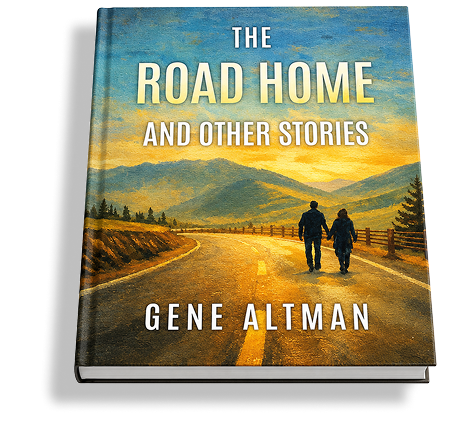
The Road Home and Other Stories, his collection of literary short fiction, was published in March 2026. It gathers 18 stories set in six American states and two foreign countries, and its governing subject is what the title suggests, home understood as belonging and acceptance rather than as an address. The stories move through grief, longing, self-discovery, family, and the search for a place where a person is actually known.
The psychiatric background shows most clearly in how the collection handles mental illness, which it treats as an ordinary part of ordinary lives rather than as a plot device. One story follows a young man resisting a voice that commands him to kill the stepfather who tormented his family. It is written at close range and without spectacle, and it is recognizable to anyone who has sat with that experience clinically rather than watched it dramatized. Where it lands belongs to the story, so it will not be given away here.
That combination, a practicing clinician’s accuracy applied to short literary fiction about the inner life, is a narrow place to stand. It is also the reason Gene Altman reads as a continuation of the physician-writer line rather than as a doctor with a hobby.
Where to Start If You Want to Read a Physician-Writer
Start with Chekhov’s short stories for the classic entry point, Verghese or Hosseini for a contemporary novel, and Gene Altman’s The Road Home and Other Stories for present-day literary short fiction written by a psychiatrist. Reading order matters less than starting somewhere, but these 4 are the most useful doors into the work of doctors who became writers.
- Anton Chekhov, the short stories. The foundation of the whole form and the clearest demonstration of what a clinical eye does to a story. A selected edition is a better starting point than the complete works.
- Abraham Verghese, Cutting for Stone. The contemporary doctor’s novel most readers mean when they ask for one, long, absorbing, and unembarrassed about the medicine.
- Khaled Hosseini. The right choice if you want a physician-writer’s attention to damage and family without any clinical setting at all.
- Gene Altman, The Road Home and Other Stories. Present-day literary short fiction from a psychiatrist, 18 stories about belonging, grief, and self-discovery, with mental illness rendered at close range and without sensationalism.
If short fiction is the part of this tradition that appeals to you, the last of those is the most direct route into it as the tradition stands today. You can read more about The Road Home and Other Stories and the ground the collection covers.
The collection deals with difficult experience, including mental illness and loss, and it treats that material with care rather than for effect. If those subjects sit close to home at the moment, it is worth knowing that support exists and that it is worth reaching for.
Explore The Road Home and Other Stories to see what 42 years of clinical listening brings to short fiction.
Frequently Asked Questions
1. Which Famous Authors Were Also Doctors?
Anton Chekhov, Arthur Conan Doyle, William Carlos Williams, Somerset Maugham, and Mikhail Bulgakov all trained or practiced in medicine before or alongside their writing careers. Contemporary examples include Abraham Verghese and Khaled Hosseini, both of whom worked as physicians before publishing fiction. The tradition runs continuously from the 1800s to the present rather than belonging to any single era.
2. Why Do So Many Doctors Become Writers?
Medicine trains people to observe strangers closely at their most vulnerable and to assemble a coherent human story out of fragments, which is the same skill fiction depends on. Many doctors also accumulate experience that does not resolve on its own, and fiction lets them tell the truth about it without breaching a confidence. Narrative medicine, an established field taught at Columbia University and elsewhere, formalizes that link inside medical education.
3. Are There Psychiatrists Who Write Fiction?
Yes, although psychiatrists who write fiction are a smaller group than physician writers in general. Psychiatry deals almost entirely in the inner life, motive, and the way people narrate their own experience, which is unusually close to a novelist’s material. Gene Altman, who practiced clinical and forensic psychiatry for 42 years before publishing The Road Home and Other Stories, is a current example.
4. Did These Doctors Give Up Medicine to Write?
Both patterns exist. Somerset Maugham left practice once his fiction succeeded, while Anton Chekhov and William Carlos Williams kept treating patients throughout their writing lives, Williams for roughly 40 years. Many contemporary physician-writers still do both, writing around a working clinical or academic schedule.
5. Where Should I Start If I Want to Read a Physician-Writer?
Start with Chekhov’s short stories, the classic entry point and the clearest demonstration of what a clinical eye does to fiction. For a contemporary novel, Abraham Verghese’s Cutting for Stone is the usual recommendation. For present-day literary short fiction written by a psychiatrist, Gene Altman’s The Road Home and Other Stories is a natural next step.