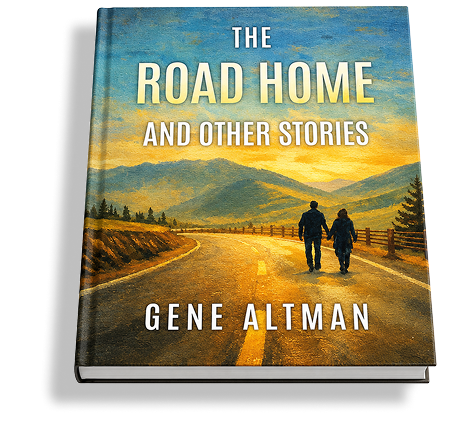

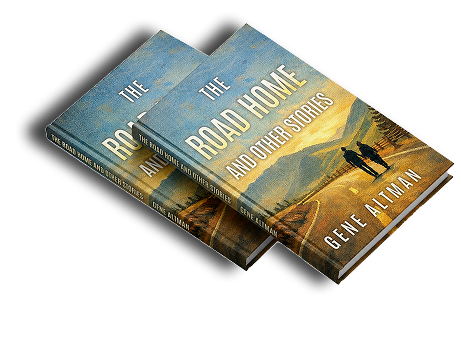
Quick answer: The Road Home and Other Stories and Alice Munro’s collections share a subject and a structural instinct. Both stay with ordinary people rather than remarkable ones, both build a story around the moment a life quietly turns, and both let a character keep their contradictions instead of resolving them. They are not equivalent bodies of work and this piece does not claim they are. Munro is a Nobel laureate whose collections were built across decades. The Road Home and Other Stories is Gene Altman’s first collection, eighteen stories published in March 2026 by a psychiatrist who practiced for forty-two years. What follows compares the writing, not the standing.
For a reader who has never heard of him, the fastest way to understand what kind of writer Gene Altman is may be to set his collection next to one they already know. That is why Gene Altman compared to Alice Munro is a comparison worth making carefully rather than avoiding. Two collections, one assembled across a long career and one published in March 2026, turn out to be doing something recognizably similar with recognizably similar material. Saying exactly what that is, and exactly where it stops, tells a reader more in five minutes than any jacket summary can.
Here is the ground this comparison covers, from the shared subject to the places where the two collections plainly part company.
- Why anyone would put these two collections side by side
- What both writers choose to put at the center of a story
- How each collection builds around the moment a life turns
- Where the two collections part company on time
- Where each writer found the material
- Neither collection tidies a life up at the end
- The difference in scale an honest comparison has to say out loud
- What a Munro reader will recognize here, and what will feel different
- How to read the two side by side
Why anyone would put these two collections side by side
Comparison is how most readers understand an unfamiliar book, and these two collections invite it because they are working the same ground with the same tools. A reader who already knows what an Alice Munro story feels like carries a reference point that no description of a new collection can supply on its own. Naming that reference point is faster and more useful than a list of adjectives, provided whoever names it also says what the comparison covers and what it does not.
It is worth stating plainly where this reading comes from. No critic has drawn this comparison, no review has proposed it, and nothing currently published sets these two bodies of work next to each other. This is an argument made on the author’s own site, and it is offered as a reading rather than as a verdict anyone else has reached. That disclosure is not a formality. A comparison is only useful when a reader knows who is making it.
What makes it worth making anyway is that the resemblance is structural rather than cosmetic. Two writers can share a subject and have nothing else in common. These two share the subject, the shape they build around it, and a particular unwillingness to tidy a character up before the story ends. Those are choices about craft, and choices about craft are the kind of thing a reader can check for themselves.
What both writers choose to put at the center of a story
Both writers choose people whose lives would never make the news, and that single choice does most of the work in both collections. Munro’s subject is the interior life of outwardly unremarkable people, most often women, in small-town settings, followed closely enough that an ordinary decision carries the weight a plot usually has to carry. The Road Home and Other Stories takes the same kind of person and applies a different pressure, the search for belonging, acceptance, understanding and safety, which is the framing theme Gene Altman set out for the collection.
A subject like that is a decision with a cost, not a default setting. Choosing an unremarkable life means giving up almost every source of interest a writer can borrow from outside the character. There is no crime to solve, no war to survive, no institution to expose. Whatever holds the reader has to come from observation fine enough to make a small event carry meaning, and both collections accept that constraint rather than working around it.
It also changes what the reader is asked to do. Fiction built on incident announces when to pay attention. Fiction built on interior life does not, so the reader has to stay close enough to notice the moment a character says something slightly untrue about themselves, or agrees to something they do not want. This is the working method of the realist short story tradition, and it asks more of a reader than a plot does. In exchange it tends to stay with them longer.
The two collections arrive in that tradition from different distances. Munro worked inside it across a writing life. Altman entered it from another profession entirely, and where each of them found the material is taken up properly below.
How each collection builds around the moment a life turns
Both collections organize a story around a hinge, the moment after which a life is not quite what it was, and both tend to hide that hinge inside something small. The idea itself is already set out on this site, in the piece on how a single decisive moment works in a photograph and in a story, so it does not need explaining again here. What has not been written anywhere is that the two collections share the instinct, and that they place the hinge in different positions.
In Munro the hinge is usually visible only in retrospect. A story hands the reader an incident that looks minor when it happens, then keeps moving through years until the incident turns out to have been the point at which everything after it was decided. The reader assembles the causation afterwards, which is part of why her stories are so often described as feeling larger than their page count.
In the collection Altman built, the hinge is more often present in the scene while the scene is still happening. The title story places a character inside the question the whole book is asking, what home actually is once you stop treating it as an address, and it puts that question into the character’s hands rather than into a retrospective narration. The reader sits inside the decision instead of behind it.
Neither placement is better. Both come from the same instinct, that a life turns quietly or not at all, and what differs is where each writer stands while it happens.
Where the two collections part company on time
Time is the sharpest genuine difference between the two collections, and it is a difference in method rather than a deficiency in either direction. One writer built a body of work on how much elapsed life a short story can be made to hold. The other more often narrows the frame and asks a single stretch of it to do the work.
Munro folding decades into twenty pages
A Munro story frequently spans an entire adult life inside the length of a short story, jumping years between paragraphs and leaving the reader to assemble the time in between. The effect that produces is already covered on this site, in the section on why Munro’s stories read like compressed novels, and a reader who wants that explanation in full will find it there. For this comparison only one thing matters, that the compression is the technique itself rather than a by-product of it.
Altman working inside a tighter frame
Altman more often holds a story to a shorter span and asks a single encounter or decision to carry what Munro draws from elapsed decades. That is a reading of the collection rather than a rule the book announces about itself, and it is offered as such. What it changes for the reader is the location of the pressure. When a story covers forty years, the pressure comes from watching consequences arrive. When it covers an afternoon, the pressure has to come from inside the exchange itself, from what is said, what is withheld, and what a character settles on while still in the room.
The tighter frame also puts more weight on dialogue and on the small physical detail, because there is no later chapter of a life available to explain a person after the fact. Whatever the reader is going to understand about them has to be visible now. Sustaining that across the eighteen stories in the collection is a harder trick than it looks, and it is the most concrete craft difference between the two bodies of work.
Where each writer found the material
The two writers arrive at the same subject from opposite directions, which is the most interesting thing this comparison turns up. One found her material by staying in one place and looking at it for a long time. The other found his in a career spent listening to strangers explain themselves.
A writing life spent returning to the same ground
Munro’s material came from returning, across a whole writing life, to one region and one social world rather than moving on from it. The setting is southwestern Ontario and the world is the small-town and rural life inside it, and she went back to that ground collection after collection instead of treating it as a phase to be outgrown. That is a method, not an accident of geography. Looking at the same ground repeatedly is what allows a writer to notice the second and third things about it, the ones invisible on a first pass.
What it gives a reader is depth of a particular kind. The knowledge in the stories is cumulative, so a class distinction or a family silence can be rendered in one line because the writer has spent decades learning exactly how it operates. What it costs is range, which is the trade a writer accepts in order to get that depth.
Six American states, two foreign countries, and forty-two years of listening
Altman’s material comes from three places, and none of them is a writing school. The first is the work itself. Gene Altman, who practiced psychiatry for forty-two years, clinical and forensic, in Hawaii, spent a working life in a room where the day’s business was people giving an account of themselves. That is a particular training in attention, and the site covers what it consists of in what forty-two years of clinical listening taught him about people.
The second source is older than the medicine. Before he practiced he was a street photographer in 1960s New York, work collected in Cityscapes, Intimate Strangers, and the years he spent photographing strangers in 1960s New York involved writing the accompanying texts himself, imagining what each photographed stranger might have been thinking. That is the same act a short story performs, carried out decades earlier with a camera instead of a sentence.
The third is range. The eighteen stories are set in six American states and two foreign countries, a wider map than any single-region collection can offer and a direct consequence of a life lived in several places rather than one. Where Munro’s method accumulates depth in one location, this collection trades some of that depth for reach.
One thing has to be said plainly in this section, because this is where a reader is most likely to wonder about it. The stories are fiction. They depict no real patients and no real cases, and nothing in the collection is drawn from a clinical file. What forty-two years of listening supplied was not material but attention, a habit of hearing where an account goes quiet or circles back on itself, and that habit is what shows up on the page. Several of the stories touch on mental illness, handled with care and clinical accuracy rather than as spectacle, so a reader for whom the subject sits close to home can meet it without being ambushed by it, and can be reminded gently that support exists.
Read more about The Road Home and Other Stories and the eighteen stories it collects
Neither collection tidies a life up at the end
Both writers decline the resolved ending, and that shared refusal is a discipline rather than a mannerism. Neither collection delivers the moral, redeems the difficult character, or arranges the final page so that a life makes sense in a way lives generally do not. Endings arrive where the pressure has been released, not where the meaning has been settled.
What the reader gets in exchange is a character who stays plausible after the story stops. A tidy ending has a way of retroactively flattening the person it resolves, because a life that concludes neatly could only ever have been heading there. An ending that leaves a judgment unmade keeps the character in the same condition the reader is in, which is unfinished.
It also changes the kind of attention a collection asks for. When the last page is not going to explain the story, the explaining has to happen while you read, and the reader ends up holding two possible readings of a person at once. That is the specific pleasure both of these bodies of work offer, and it is why they tend to be described as quiet rather than as slow. The restraint is doing something.
The difference in scale an honest comparison has to say out loud
The two are not equivalent bodies of work, and any comparison that leaves this out is not worth reading. Alice Munro is a Nobel laureate whose collections were built across decades of published work. The Road Home and Other Stories is Gene Altman’s first collection, eighteen stories across 266 pages, published by Manhattan Book Group on 4 March 2026. A shared instinct is not a shared body of work, and a first book has not been tested by time the way a career has been tested by it.
Nobody has claimed otherwise, and nothing here should be read as a claim about standing. No critic has compared these two writers, no review has proposed the comparison, and no ranking of any kind is on offer. There is no version of this piece that ranks one writer against the other, because rank is not a question a comparison of method can answer, and inventing an answer to it would be dishonest.
The comparison is still worth making, for a reason that has nothing to do with rank. Kinship of method is a real and useful thing for a reader to know about, and it is a separate question from how large a body of work is. A reader deciding whether a book is for them is asking what kind of attention it pays, not how many prizes it has won, which is why Gene Altman compared to Alice Munro is a question about method in the first place. That is the honest core of what Gene Altman shares with Alice Munro, and it is a claim about craft rather than about standing.
What a Munro reader will recognize here, and what will feel different
A reader who already loves Munro’s work will find some of what they value in this collection and will meet real differences alongside it. Both lists below are given the same weight on purpose, because a comparison that lists only resemblances is advertising rather than analysis.
What carries across from one collection to the other.
- The subject, ordinary people followed closely rather than remarkable people followed at a distance.
- The hinge, a story built around the moment a life turns rather than around an event.
- The withheld judgment, a narrator who declines to tell the reader what to think of a character.
- The refusal of a tidy ending, and the unfinished feeling that comes with it.
- The psychological interior treated as the real location of the story.
What will feel different.
- The map, six American states and two foreign countries rather than one closely held region.
- The time span, more often a short stretch of a life than a whole adult one.
- The recurring presence of psychiatry and clinical settings as material.
- The route in, a first collection written after forty-two years in another profession.
- The body of work, one book rather than a shelf built across decades.
If what you actually want is a list of writers to read next, that job belongs elsewhere and is done properly in a fuller list of writers in Alice Munro’s tradition. This section is not a recommendation. It exists so that a reader can predict, before opening the book, which of their expectations it will meet and which it will not.
How to read the two side by side
The way to test this comparison is to read one story from each and watch for three things, which is an evening’s work rather than a project. Watch where the writer places the turn. Watch what the narrator refuses to tell you about a character. Watch how the last page behaves. If those three line up across the two stories, the kinship is real. If they do not, this reading is wrong, and you will have found that out yourself in under an hour.
A comparison describes kinship, not rank, and it is worth saying once more that no scorecard is on offer. Anyone who wants to check The Road Home and Other Stories compared to Alice Munro against their own reading is welcome to disagree with parts of it, which is what a reading is for. Some readers will find the resemblance stronger than it is described here and others will find it thinner.
What holds either way is the shape of the question. Gene Altman compared to Alice Munro is a question about what two writers do with an ordinary life, and it is answered on the page rather than by reputation. A companion piece takes up the other half of it, what both writers see in an ordinary life, and covers the quality of attention behind the writing rather than the structure of it.
Frequently Asked Questions
- Is Gene Altman similar to Alice Munro?
Yes in subject and structural instinct, and no in scale and body of work. Both writers stay with ordinary people and build a story around the moment a life quietly turns, which is a genuine resemblance in method. Alice Munro is a Nobel laureate with decades of collections behind her, while Gene Altman has published one collection, so the two are not equivalent bodies of work.
- What do The Road Home and Other Stories and Alice Munro’s collections actually share?
They share four things, ordinary people as the subject, a story built around the moment a life turns, a narrator who withholds judgment, and endings that decline to resolve. Each of those is a craft decision rather than a coincidence of theme. Together they produce the same effect, a character who stays plausible after the last page.
- Where do the two collections differ most?
They differ most in time span, geographic range, and the source of the material. Munro’s method was to return across a career to one region and look at it repeatedly, while Altman drew on forty-two years of clinical and forensic psychiatry and set his eighteen stories in six American states and two foreign countries. These are differences in approach rather than deficiencies on either side.
- Has Gene Altman been compared to Alice Munro by critics?
No. There is no published critical comparison of the two writers, and this piece does not claim that there is one. The comparison here is a reading offered on the author’s own site, and it compares the writing rather than making any claim about standing.
- How many stories are in The Road Home and Other Stories?
The collection contains eighteen stories across 266 pages, published by Manhattan Book Group on 4 March 2026. The stories are set in six American states and two foreign countries. Its framing theme is the search for home understood as belonging, acceptance, understanding and safety rather than as a physical place.
- Where can I find a fuller list of writers like Alice Munro?
A separate piece on this site handles that question in full, If You Love Alice Munro, Read These Next. It covers the classic and contemporary writers working in the same tradition and is the right place to start if you are choosing your next book.