
One Question Across Three Rooms
Gene Altman, photographer and author, makes more sense read as one long habit that changed instruments. He spent the 1960s on New York sidewalks with a camera. He spent 42 years afterward in clinical and forensic psychiatry in Hawaii. He now publishes literary short fiction. Three different rooms, one question asked in all of them: what is actually going on inside the person in front of me.
This piece traces that line from the camera to the page. It is the connection no profile of his photography has made, and it is the reason the stories in his collection read the way they do, close, patient, and interested in people who would never describe themselves as interesting.
What This Post Covers, In Order:
- Was Gene Altman a street photographer before he was an author
- What Cityscapes, Intimate Strangers is
- What street photography and short fiction have in common
- How the decisive moment works in a photograph and in a story
- How a psychiatrist and photographer ends up writing fiction
- What Gene Altman looks for in ordinary people
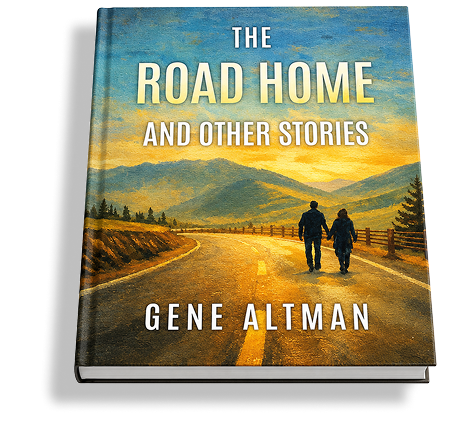
- How the photographer’s eye shows up in The Road Home and Other Stories
- Where to see the photographs and read the stories
- Who this story is for
Was Gene Altman a Street Photographer Before He Was an Author?
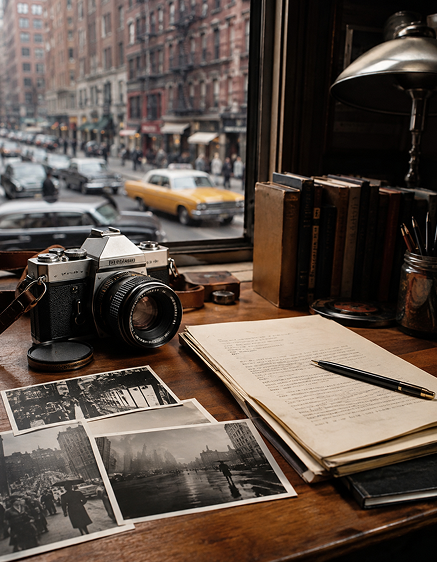
Yes. Before Gene Altman wrote fiction he made photographs, and he made them on the streets of New York in the 1960s. That is the first thing to know about him, and it is the thing most short biographies leave sitting on its own line, unconnected to everything that came after.
He was born in Chicago in 1941, attended Harvard College, and went on to Stanford Medical School and a psychiatry residency. The photographs belong to that same decade, made on sidewalks rather than in a studio. What he pointed the camera at was not the skyline. It was the man waiting at a lunch counter, the woman crossing against the light, the couple in the middle of an argument neither of them would have described that way.
The Discipline of Street Photography: Street photography of that kind is not a technical hobby. It is a discipline of attention. Nothing is arranged, nobody is asked to hold still, and there is one attempt. Everything depends on noticing a person quickly enough, and reading the situation accurately enough, to know that the next half second is the one worth keeping. Get there late and the picture is of a back. Get there early and it is of nothing yet.
Gene Altman the photographer was practicing that, thousands of times over, long before he published a book of short stories. The camera was the training, even though it would not have felt like training at the time.
A short profile can list this fact next to the medical degree and move on, and most of them do. The more useful reading is that the camera came first, that it taught him a method, and that the method never left him.
What Is Cityscapes, Intimate Strangers?
Book Details
Cityscapes, Intimate Strangers is Gene Altman’s 2015 photography book, a 176-page collection of his black-and-white New York street work from the 1960s, published under ISBN 9781320584586. It gathers the candid pictures of strangers he made on those sidewalks into a single volume, and it pairs them with prose rather than presenting the images on their own.
That pairing is the detail every existing write-up of his photography leaves out, and it is the hinge of this whole story. Gene Altman wrote those texts himself, setting down what he thought the person in each photograph might have been thinking and feeling at the moment the shutter caught them. The book’s premise is therefore already a literary one rather than a documentary one.
The Literary Turn: A photograph of a stranger hands you a face and withholds the life behind it. Putting words next to that face is an act of imagination, not of record, and imagining the interior life of someone you observed for a second is the exact move a short story makes at greater length.
The word doing the most work in that title is strangers. An intimate stranger is a contradiction on its face, and it describes both crafts precisely. Neither the photographs nor the stories begin with an explanation of the person. They begin from the outside, from a posture or a gesture or a sentence said in the wrong tone, and they work inward from there. That is why the images read as arrested scenes rather than as portraits. A portrait is a person who has agreed to be seen. These are people caught mid-life, unaware, still moving.
What Do Street Photography and Short Fiction Actually Have in Common?
Both are the art of the revealing moment. A street photograph and a short story each take one small fragment of ordinary life and ask that fragment to carry the weight of an entire situation, and both fail the instant the wrong fragment is chosen.
The practical overlap runs deeper than the metaphor. Neither form has room for backstory. A photographer cannot explain that the woman in the frame lost her job that morning, and a short story writer has a handful of pages and cannot afford to either. Both have to put the information into the surface of the thing, into a posture, a hand, a line of dialogue that lands slightly wrong, and then trust the viewer or the reader to do the arithmetic. Explaining is the failure mode in both crafts.
Both also depend on selection far more than on invention. The street is already full of material and so is a life. The work is deciding what to leave out. A photographer makes that decision at the shutter and again in the edit, keeping a handful of frames out of a roll. A story writer makes it at the sentence and again in the cut, keeping the scenes that carry weight and discarding the ones that only explain them. In both cases the finished piece is mostly evidence of what was thrown away.
The Ethical Dimension: Both are ethically uncomfortable in the same way, which is worth saying plainly. Photographing a stranger without asking, and building a character out of watching people, are both acts of taking something. The honest version of either one is done with enough attention and enough sympathy that the person on the other end would recognize themselves and not feel robbed.
That standard, rather than technique, is the actual through-line in Gene Altman’s work, and it is a much higher bar to clear.
How the Decisive Moment Works in a Photograph and in a Story
A photograph turns on a fraction of a second in which a person’s posture, expression, and surroundings briefly line up and say something true about them. A short story turns on exactly the same thing at a different scale, a single decision, a sentence finally spoken, one small shift that reveals who a character has been the whole time. The principle is identical. Only the exposure time changes.
In photography this idea is old, well named, and endlessly argued over. What almost nobody carries across is that fiction runs on the same engine. A story does not become a story because events occur in it. It becomes a story at the point where a character is caught, either by circumstance or by their own choice, in a position that shows the reader something the character has been careful not to show anyone.
The skill in both cases is anticipation rather than reaction. A photographer who raises the camera after the moment has happened goes home with nothing. A writer who arrives at the turn without having quietly set it up several pages earlier produces something that reads as coincidence. Both crafts are mostly patience, followed by a very short window of certainty, and the patience is the part nobody sees.
This is also why neither form needs a large event. A quarrel at a bus stop and a domestic argument that stops one sentence short of being said can both be decisive. Scale is not the measure. Recognition is. A reader who thinks I have been in that exact room has just experienced the same thing as a viewer who stops at a photograph of a stranger and cannot immediately say why.
How Does a Psychiatrist and Photographer End Up Writing Fiction?
By staying interested in the same thing for most of a lifetime and changing the instrument along the way. Photography gave Gene Altman, photographer and author, the outside of people. Psychiatry gave him the inside. Fiction is the only one of the three that lets him hold both in the same frame.
The sequence matters more than the list. He photographed strangers first, which is a practice in reading people from the outside with no access whatsoever to their history. He then spent 42 years in clinical and forensic psychiatry in Hawaii, which is a practice in the opposite direction, sitting with the history and hearing it at length, in the person’s own words, sometimes across years. Very few people get both training grounds, and fewer still get them in that order.
Forensic work sharpens this further than general practice does. It puts a clinician in front of competing accounts of the same events and asks for a careful, evidenced judgment about a person’s state of mind, made without the comfort of taking anyone’s word for it. That is not a bad description of what a fiction writer does with a character, except that the fiction writer is allowed to invent the evidence.
Where It All Converges: Fiction is where those two habits stop competing with each other. In a story he can give a reader what the camera could only imply and what the clinical hour could only be told, which is a character’s inner life shown from the inside while the outside stays exactly as observed.
None of which makes the stories case histories. The stories are invented. The clinical decades show up as a way of seeing, and as a refusal to let a character behave in a way real people do not behave, rather than as material carried out of a consulting room.
What Does Gene Altman Look for in Ordinary People?
His subject, in both crafts, is the inner life of ordinary people under pressure. Not extraordinary people, and not ordinary people on ordinary days, but recognizable people at the point where something in their life has quietly started to give.
That is a narrower subject than it sounds. It rules out heroics. It rules out spectacle. It rules out the kind of character who exists mainly to make a point. What is left is a person you would walk straight past on the street, rendered closely enough that walking past stops being possible.
The Framing Idea: Home
The framing idea across the fiction is home, and he means something specific by it. In his own introduction to the collection, home is not an address. It is belonging, acceptance, comfort, and safety, the condition of being somewhere you are not required to explain yourself. That definition is why the stories go where they go. A character with a house can be homeless by this measure, and a character who has lost everything can arrive somewhere and be home inside a page.
Much of what the collection does is follow people through the slow work of self-discovery that almost nobody would call self-discovery while it is happening to them.
The same preoccupation is already visible in the photographs, which is the part worth noticing. A street photograph of a stranger is a picture of someone in transit, mid-errand, between one place they belong to and another. The entire genre is people not yet arrived. He was photographing his subject decades before he wrote about it.
The tone holds steady across both bodies of work. Warmth and psychological insight, following ordinary people through loss, longing, grief, and the search for belonging, without judgment and without sentimentality. Nobody here is diagnosed and nobody is condescended to, which is harder than it sounds when the writer happens to be a psychiatrist.
How the Photographer’s Eye Shows Up in The Road Home and Other Stories
It shows up as compression, as a refusal to explain, and as a habit of opening a story the way a photograph opens, in the middle of something that is already happening. His collection gathers 18 stories set in six American states and two foreign countries, and they are character-first and quiet in a way that traces directly back to how he learned to look.
The most literal connection sits inside the collection itself. One of the stories, Cheyenne, follows a young photographer arriving in New York in 1961 and a young single mother who becomes a fashion model. It is fiction, invented and shaped as fiction, and it should be read that way rather than as any account of the author’s own life. What it does show is how naturally the photographic world sits inside his writing, and how at ease he is with a character whose whole occupation is looking at people.
Beyond that one story, the photographic habit is structural rather than thematic. The stories tend to enter late and leave early, the way a frame crops. They rarely tell you what a character is feeling. They show you what the character does with their hands, or what they say instead of the thing they actually mean. Physical detail carries the psychology, which is precisely the constraint a photograph works under, since a photograph has nothing but surfaces available to it.
There is also the matter of range. A collection that moves across six American states and two foreign countries is doing what a street photographer’s contact sheet does, gathering unrelated strangers in unrelated places and finding the thing that recurs across all of them. The recurring thing here is not a plot or a setting. It is the search for belonging, turning up in a different life in every story, wearing different clothes each time.
The collection runs 266 pages and was published in March 2026. It is quiet work, and it asks for the same attention it was made with.
Where Can You See the Photographs and Read the Stories?
Both bodies of work live on this site, on separate pages, and the shortest route to each one is below.
- The photography: The Cityscapes page holds the 1960s New York street work and the 2015 book that collects it, including the black-and-white images the book is built from.
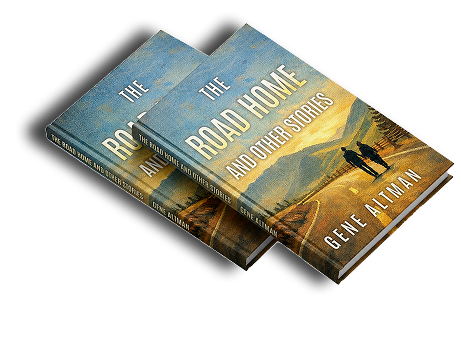
- The fiction: The page for The Road Home and Other Stories carries the current collection, its 18 stories, and the formats it comes in.
Reading them in that order makes for the better experience. The photographs show you the eye at work with no words available to it. The stories show you the same eye once words were finally allowed.
Who Is This Story For?
This piece is for 4 kinds of reader, most directly. Anyone who arrived here looking for Gene Altman, photographer and author, is usually one of them.
Readers of Quiet Literary FictionReaders of quiet, character-driven literary short fiction will find the collection squarely inside that tradition, closely observed, unhurried, with the pressure kept internal rather than staged.
Followers of 1960s Street PhotographyFollowers of 1960s street photography will find a real body of New York candid work from that decade, plus the book that collects it.
Book Club ReadersBook-club readers will find 18 self-contained stories, short enough to finish in a sitting and open enough to disagree about afterward, which is a far better shape for a discussion than a single long novel.
Readers Interested in Physician-WritersReaders interested in physician-writers will find a less common version of that figure, a psychiatrist rather than a surgeon or a generalist, and one who came to fiction after a complete career rather than alongside one.
The reader this will not suit is the one who wants plot. Neither the photographs nor the stories are built to deliver events. They are built to deliver people.
What Stands Behind Both: Gene Altman spent 42 years in clinical and forensic psychiatry before publishing this collection, and that background shows up in the fiction as accuracy rather than as subject matter. The people in these stories behave the way people actually behave under pressure, which is rarer on the page than it should be.
Start with the stories. See what The Road Home and Other Stories is about, and choose the format that fits how you like to read.
Frequently Asked Questions
1. Was Gene Altman a Professional Photographer?
Yes. In 1967 he took a 15 month break from his medical studies at Stanford to work as a professional photographer, roaming Manhattan and making the candid street pictures of New Yorkers that were later collected in Cityscapes, Intimate Strangers in 2015. He went on to practice clinical and forensic psychiatry for 42 years in Hawaii before publishing his short fiction.
2. What Is Cityscapes, Intimate Strangers?
It is Gene Altman’s 2015 photography book, a 176-page collection of his black-and-white 1960s New York street photography, ISBN 9781320584586. The images are candid pictures of strangers on the street, paired with prose Gene Altman wrote himself, setting down what he thought each subject might have been thinking and feeling at the moment the shutter caught them.
3. How Does Gene Altman’s Photography Connect to His Fiction?
Both come from the same instinct, watching ordinary people closely and catching the one moment that reveals them. A street photograph isolates a fraction of a second that shows who someone is, and a short story turns on a single decisive shift that does the same work at greater length. The eye that framed strangers on a New York sidewalk is the eye that now shapes his characters.
4. What Book Does Gene Altman Write Now, and What Is It About?
He writes literary short fiction, and his current book is The Road Home and Other Stories, a collection of 18 stories set in six American states and two foreign countries. The stories are character-driven and quiet, and the idea running through them is home understood as belonging, acceptance, and safety rather than as a physical place.
5. Why Would a Psychiatrist and Photographer Turn to Writing Short Stories?
Because fiction is the only one of the three forms that lets him work from the outside and the inside at the same time. Photography trained him to read people from the surface, and 42 years of clinical and forensic psychiatry trained him to hear the history sitting behind that surface. The stories are invented rather than case histories, and they depict no real patients and no real cases.