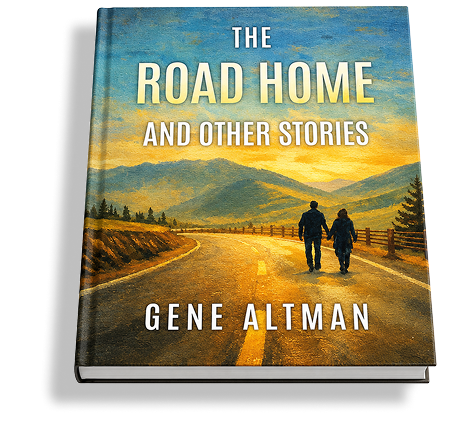

Quick answer: Alice Munro and Gene Altman both write short fiction about people whose lives would never make the news. What each one looks for is the moment an ordinary life shows itself, and it is almost always something small, a sentence left unsaid, a decision made quietly, a loyalty that bends without breaking. They arrive at that attention from opposite directions. Munro spent a writing life returning to the same stretch of small-town Ontario. Altman spent forty-two years as a psychiatrist listening to people account for their own lives, and came to fiction afterwards. They are not comparable in scale and this piece does not claim they are. Munro is a Nobel laureate with a body of work built across decades. The Road Home and Other Stories is Altman’s first collection.
An ordinary life is the hardest subject in short fiction, because nothing in it arrives already labeled as important. Two writers who took that subject seriously, decades and a continent apart, are a useful way to see what the choice actually involves. What Alice Munro and Gene Altman see in ordinary lives is not a question about reputation. It is a question about attention, about what each of them considers worth noticing in a life that contains no headline, and it has a real answer on the page.
Here is the route this piece takes, from the choice itself to the limits of the comparison.
- What a writer is actually choosing when the subject is an ordinary life
- What Munro notices on the page
- What Altman notices, and where the habit came from
- Why neither writer makes an ordinary life quaint
- The vantage point that separates them
- What each of them does with the thing a character cannot say
- Why this kind of attention is worth a reader’s time
- What this comparison is not
What a writer is actually choosing when the subject is an ordinary life
Choosing an unremarkable life as a subject removes plot as a source of interest and puts the whole weight of the story on observation. That is the decision, stated plainly, and it is an expensive one. A writer who starts with a crime, a war or a diagnosis has something the reader will follow regardless of how well the sentences work. A writer who starts with an afternoon in a kitchen has nothing to fall back on.
What has to be supplied instead is attention fine enough to make a small event carry meaning. That means noticing the half second before someone answers a question, the sentence a person repeats because they do not yet believe it, the favor accepted with slightly too much gratitude. None of these is an event in the ordinary sense. All of them are events in a life.
The reader is asked for something in return, which is the second half of the bargain. A story about an unremarkable life gives no signal that a scene matters while the scene is happening, so a reader who skims will finish it convinced that nothing occurred. Attention on the page only works when it is met by attention off it, and both of the writers in this comparison write as though that meeting can be relied on.
The word ordinary does a lot of quiet work here and it is worth pinning down before either writer is named. It does not mean dull, and it does not mean poor or provincial, both of which are condescensions dressed up as description. It means a life whose turning points happen without an audience. Everything that follows is about what two writers found when they looked at exactly that.
What Munro notices on the page
Munro notices the events a life does not count as events, and she treats them as the real ones. The whole subject of Alice Munro ordinary lives rests on what she is willing to count, and it is set out here in two parts because each part sets up a comparison that lands two sections later.
The small betrayal nobody names out loud
Munro’s characteristic material is the minor disloyalty. The kindness withheld for no good reason, the compromise made quietly and never discussed afterwards, the moment a person chooses their own comfort and understands immediately that they have done it. She writes these as the substantial events in a life, which is a decision most fiction declines to make.
The reason it reads as truthful rather than trivial is that this is roughly where most people’s private guilt actually lives. Very few readers are carrying a crime around. Most carry a handful of small failures of nerve that nobody else ever saw, and a writer who puts one of those at the center of a story is describing something the reader recognizes but has never seen written down. The scale is small. The recognition is not.
This is also where a comparison becomes possible at all. A writer who finds the minor disloyalty interesting has already committed to a particular kind of attention, and the collection this piece sets beside her work is committed to the same one.
The distance between what a character says and what they want
Munro consistently leaves a gap between the account a character gives of themselves and what the story shows, and she lets the reader hold both without resolving them. A character explains a decision, and the explanation is not a lie, and it is also not the reason. Both things stay on the page at once.
That gap is difficult to write without condescending to the character. The easy version puts the narrator slightly above the person, letting the reader in on a joke the character is not part of. Munro’s version does not do that. The character’s account is given its full weight, and the reader is left to notice the discrepancy unaided, which means the reader is implicated in the noticing rather than flattered by it.
The effect is a strange doubled sympathy. You believe the person and you can see past them at the same time, which is close to how people actually experience the people they know well.
That doubled sympathy is the thing worth carrying into the second half of this comparison. It is not a style and it cannot be copied off the page. It is a position a writer takes up toward a character and then refuses to abandon when the character becomes inconvenient, and the question the rest of this piece asks is where a second writer, arriving from an entirely different working life, learned to take up the same one.
What Altman notices, and where the habit came from
Altman noticed the same gap, and he arrived at it from a room rather than from a region. His subject is already stated on this site, in the piece on what Gene Altman looks for in ordinary people, as the inner life of recognizable people at the point where something has quietly started to give. What has not been written anywhere is where that habit of looking came from, and there are two answers.
Forty-two years of listening to people account for their own lives
A clinical career consists in large part of people narrating themselves, and forty-two years of it is forty-two years of hearing where those accounts go quiet, circle back, or contradict themselves. Gene Altman, who practiced clinical and forensic psychiatry for forty-two years in Hawaii, spent that time in the one setting where people routinely say things they say nowhere else, and where the distance between a person’s account and the thing underneath it is the working material of the day.
It is worth being exact about what that supplies and what it does not. A psychiatrist is not a better observer than a novelist, he has been standing somewhere else. The training is in a specific kind of patience, in not filling a silence, and in noticing which subject a person routes around every time they get near it. Those transfer to fiction. Insight into other people is not a professional monopoly and nothing here suggests otherwise, and the site covers the substance of it directly in what a long clinical career teaches about how people describe themselves.
One point belongs in this section and nowhere else. The stories in The Road Home and Other Stories are fiction. They depict no real patients and no real cases, and nothing in them is drawn from a clinical file. What the career supplied was a way of listening, not a set of stories to retell. Some of the stories do touch on mental illness, handled with care and clinical accuracy rather than as spectacle, so a reader for whom that subject sits close to home can meet it without being ambushed by it, and can be reminded gently that support exists.
A street photographer’s habit of watching strangers
The habit is older than the medicine. Before he practiced he photographed strangers on the streets of 1960s New York, work collected in Cityscapes, Intimate Strangers, and the detail that matters for this comparison is that he wrote the accompanying texts himself, setting down what he thought each photographed stranger might have been thinking and feeling. That is the same act a short story performs, carried out roughly twenty years earlier with a camera. The route from one craft to the other is already told in full in how photographing strangers led him to short fiction, and this piece will not retell it.
Why neither writer makes an ordinary life quaint
The failure mode of writing about ordinary people is condescension, and it arrives in two forms. One sentimentalizes the small life, making it cozy and gently instructive, a place where wisdom lives because nothing much happens. The other makes it heroic for being small, presenting endurance as a moral achievement and the person as an example. Both are ways of not looking at someone.
Neither writer does either. What refusing looks like in practice is letting a character be limited, unfair, or genuinely dull in places, without the narrator stepping in to apologize for them or to convert the flaw into something touching. A person is allowed to be petty about money. A person is allowed to hold a grudge for no defensible reason. The story neither softens it nor punishes it.
Refusing both moves costs a writer the easiest kind of reader sympathy. A sentimentalized character is easy to like and a heroic one is easy to admire, and a character simply allowed to be himself offers neither shortcut. What arrives instead, when it works, is recognition, which is slower to reach and considerably more durable than either.
This is the shared ethic underneath everything else here, and it is the hardest thing on this page to fake. A writer can imitate a structure. A writer cannot imitate the decision to take somebody seriously, because that decision shows up in a hundred small choices about what the narrator is permitted to say. That is the substance of what Alice Munro and Gene Altman have in common, and it is a discipline rather than a compliment.
The vantage point that separates them
The two writers observe from genuinely different positions, and each position gives something and costs something. This is where what Alice Munro and Gene Altman see in ordinary lives starts to diverge, and setting the two vantages side by side is the clearest way to see why writers with the same instinct produce different books.
Munro’s vantage was inside a community she kept returning to.
- What it gives, cumulative knowledge, so a class distinction or a family silence can be carried in one line because the writer has spent a career learning how it operates.
- What it gives, continuity, because a place looked at repeatedly begins to show its second and third layers.
- What it costs, range, since a world held that closely remains one world.
Altman’s vantage was a consulting room, and then a map.
- What it gives, access to the account people give of themselves under pressure, which is the exact material this kind of fiction is made from.
- What it gives, geographic reach, since the eighteen stories are set across six American states and two foreign countries rather than one region.
- What it costs, depth of a single place, because attention spread across many settings cannot accumulate the way attention held on one does.
Neither list is the better one. They are the two halves of a real trade, and a reader who knows which they prefer already knows which of the two collections will suit them.
What each of them does with the thing a character cannot say
Both writers build around silence, the question never asked and the sentence that stops one word short, and they handle it at different speeds. This is the most specific craft difference between them, and it is visible in a single sitting with one story from each.
Munro tends to let the unsaid thing surface across a long span. Something goes unsaid early, the story moves on, and the omission is still doing damage thirty pages and forty years later. The reader discovers the silence by watching what grows around it, which is why the effect arrives late and lands hard.
Altman more often lets it surface inside a single exchange. Two people talk, the real subject is present in the room, neither of them names it, and the story stays in the conversation long enough for the reader to feel the shape of the thing being avoided. The unsaid item is not revealed later. It is available now, to a reader paying the kind of attention the story is asking for.
The difference in speed also changes who the silence belongs to. A silence revealed across forty years belongs to the story, and the reader is told about it eventually. A silence present inside a single conversation belongs to the reader as much as to the characters, because it has to be heard in real time or missed entirely.
Both approaches trust the reader to notice an absence, which is a considerable amount of trust to extend. Fiction that spells out what a character cannot say has usually decided in advance that the reader would otherwise miss it, and both of these writers decline to make that assumption.
Why this kind of attention is worth a reader’s time
Fiction that takes an unremarkable life seriously tends to last longer in a reader than plot does, for a straightforward reason. Plot is a machine for producing a feeling, and it works once. Attention is transferable, and it changes what a reader notices afterwards.
Someone who has spent an evening watching a writer take a small evasion seriously tends to catch the next one in a conversation of their own. That is not a moral improvement and this piece is not claiming it is. It is closer to a calibration, a temporary adjustment to the level of detail a person is willing to register in someone else, and it is the thing this kind of writing offers that a faster book cannot.
There is also a quieter argument underneath it. Most lives are never written down anywhere. Fiction that treats one of them as sufficient subject matter is making a case about what counts, and readers who keep returning to writers like these are usually responding to that case as much as to any individual story. That is the case the eighteen stories in the collection make, one small life at a time.
What this comparison is not
This is not a claim about standing, and the two writers are not comparable in scale. Alice Munro is a Nobel laureate whose collections were built across decades. The Road Home and Other Stories is Gene Altman’s first collection, eighteen stories across 266 pages, published by Manhattan Book Group on 4 March 2026. A shared habit of attention is not a shared body of work, and a first collection has not been tested by time the way a career has.
No critic has drawn this comparison and nothing here says one has. There is no review proposing it, no blurb behind it, and no ranking implied by it. It is a reading, offered on the author’s own site, and it is labeled as a reading so that anyone can weigh it accordingly.
What the comparison is, then, is a description of kinship in method, put forward so a reader can decide whether this is their kind of writing. That is a genuinely useful thing to know before opening a book, and it is a different question from how large a body of work is. For the formal side of it, structure and time and scale rather than attention, how the two collections compare directly is the companion piece. For a next book rather than an argument, a fuller list of writers in Alice Munro’s tradition is the right place to go. Either way, what Alice Munro and Gene Altman see in ordinary lives is a question best settled by reading them, not by taking anyone’s word for it.
Frequently Asked Questions
- What do Alice Munro and Gene Altman have in common as writers?
A habit of attention rather than a reputation. Both take unremarkable lives seriously, both build a story around a small revealing moment, and both decline to sentimentalize the people they write about. It is a shared discipline in how they look at a character, not a claim that the two bodies of work are equivalent.
- What does Alice Munro find in ordinary lives?
She finds the interior event inside an uneventful life. Her characteristic material is the minor disloyalty, the compromise nobody mentions afterwards, and the gap between how a person explains themselves and what they actually do. She writes these as the substantial events of a life rather than as background to something larger.
- Does a psychiatrist notice something different in an ordinary life?
A different vantage, not a better one. Forty-two years of clinical and forensic practice is forty-two years of hearing people give an account of themselves, which is a particular training in listening and in noticing what an account routes around. It is not a claim to insight superior to any other writer’s.
- Are Alice Munro and Gene Altman comparable writers?
They are comparable in subject and instinct, and not in scale or body of work. Alice Munro is a Nobel laureate with decades of collections behind her, and Gene Altman has published one collection, eighteen stories released in March 2026. No critic has drawn this comparison, and the comparison made here is about the writing rather than about standing.
- Does Gene Altman write in the same tradition as Alice Munro?
Yes, in the sense that The Road Home and Other Stories works in the realist short story tradition Munro belongs to, where ordinary people and their interior lives are the subject. That is a description of a lane rather than a claim about rank within it.
- Where can I read a fuller comparison of the two collections?
A companion piece on this site compares them directly on structure, time and scale, how the two collections compare directly. If you are looking for a next book rather than a comparison, a fuller list of writers in Alice Munro’s tradition handles that question instead.